


Fast Food POS System for Small Takeaway Shops in Hong Kong: What to Test at Lunch Rush
 Jul 14,2026
  By Tappo Team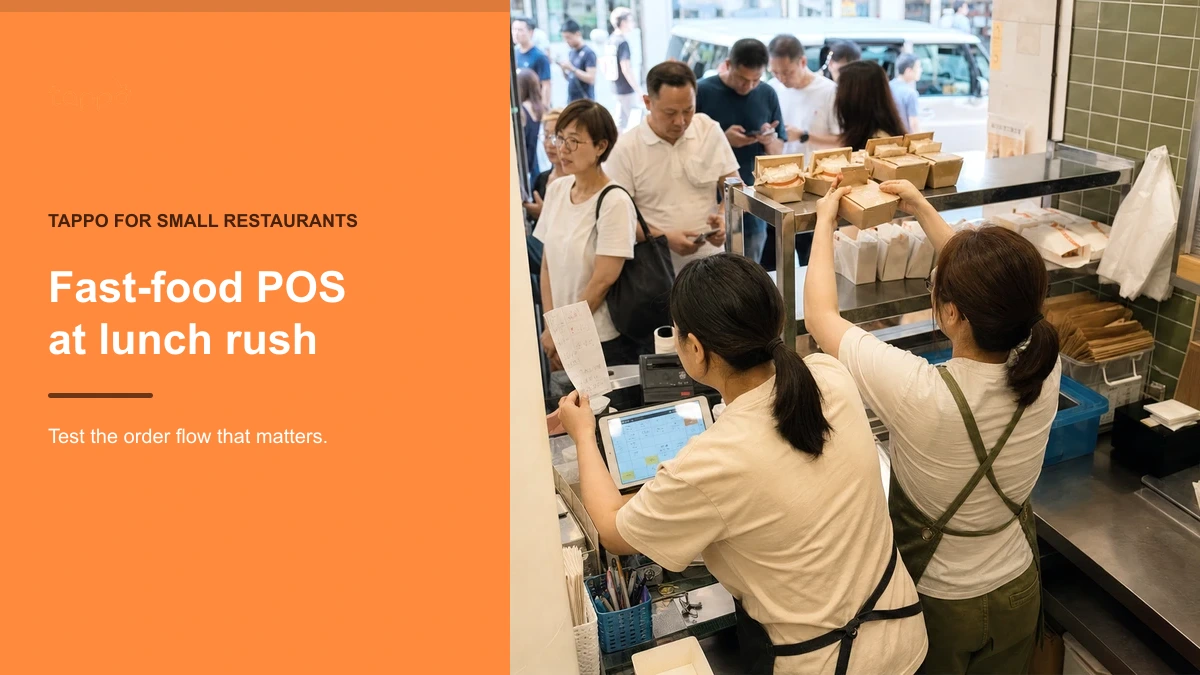
Reviewed by: Tappo Team Last updated: July 2026
The quietest moment is a poor time to judge a POS system. A small takeaway shop can look organised when one order is on the counter. Lunch rush is where the gaps show up: an item sells out, a customer changes an order, staff need to see what is next, and several people arrive to collect food at once.
In short
For a small Hong Kong takeaway shop, test a fast-food POS against one busy shift: enter several orders, change a menu item, hand off preparation and complete customer pickup. Choose only after staff can see the next action at each step.
A fast-food POS system should be tested against the shop’s busiest real order flow, not only a short feature demo. For a small takeaway shop, the key test is whether order entry, menu changes, preparation handoff and customer pickup remain clear when several orders arrive together.
- Best for: small single-location fast-food and takeaway shops where customers collect their own orders.
- Ask first: whether your main pressure is at the counter, in the menu, during preparation handoff or at collection.
- Confirm separately: any specific payment method, hardware, kitchen display, automatic notification, delivery-platform, offline or multi-branch requirement.
If you are still comparing POS options at a higher level, start with Restaurant POS System in Hong Kong: How to Compare Options.
Use One Busy Shift As The Test Case
Rather than asking a supplier to show every feature, bring one realistic lunch-rush situation to the trial. For example:
> A customer orders a set meal, another asks for a change, one menu item becomes unavailable, and two earlier customers arrive to collect while new counter orders continue.
This is useful because it tests the points where a small team can lose track. The goal is not to make the shop look like a large chain. It is to see whether staff can keep the next action obvious.
| Moment in the shift | What should stay clear | What to observe in a trial |
|---|---|---|
| A new order arrives | Who takes it and how it is recorded | Can staff enter a normal order without slowing the queue? |
| A menu item changes | What the customer and staff can still order | Can the team make a menu change without creating confusion? |
| Food moves to preparation | Which order is being worked on next | Is the handoff understandable to the people preparing food? |
| Customers collect | Which order belongs to which customer | Can staff check the order before handing it over? |
| A mistake happens | Who notices and what is corrected | Can the team resolve it without guessing which order is affected? |
The Counter Is Only The First Checkpoint
For a small fast-food shop, fast counter entry matters, but it is not the whole workflow. A system can look quick at the first screen and still cause pressure later if staff cannot tell whether an order has been prepared or collected.
During a demo or trial, ask a staff member to enter several ordinary orders in a row. Then add one real-life interruption, such as a customer changing an item or a sold-out dish.
The useful question is not “does the system have a counter screen?” It is “can the person on the counter keep serving customers while the rest of the team understands what happens next?”
Menu Changes Need To Be Tested Under Pressure
Fast-food menus often look simple, but small changes can cause a chain of mistakes during a busy period. A sold-out item, a price change or a different set option affects both the customer-facing menu and the staff handling the order.
Test a realistic change before choosing a system:
- remove one item temporarily;
- update an option or set-meal description;
- check whether the person taking orders sees the same menu as the customer;
- place a new order after the change; and
- make sure staff can still identify what must be prepared.
For a deeper guide to menu edits, sold-out items and options, see QR Menu and POS Menu Editing for Small Restaurants.
Self-pickup Is A Handoff Problem, Not A Delivery Claim
Many small Hong Kong takeaway shops let customers order and collect food themselves. That may happen at the counter, through a QR code, or before the customer arrives at the shop. It is a customer self-pickup flow, not a delivery-platform workflow.
The simplest test is to run several collection scenarios at once. Can the team tell which order is ready, which customer is waiting, and what to check before food leaves the counter?
If the takeaway shop operates inside a food court, venue rules and a compact counter add another layer. Use the food court stall setup checklist to test those constraints before choosing the system.
If your main decision is how customers place takeaway or self-pickup orders, read Online Ordering System for Takeaway and Self-pickup in Hong Kong. This article is narrower: it helps you test whether the shop can keep the busy handoff clear after orders are already coming in.
A Small-Team Trial Scorecard
Use this scorecard after a realistic trial. It is more useful than asking whether a system has a long feature list.
| Test result | What it may mean | Next step |
|---|---|---|
| Staff can enter orders, update the menu and verify collection without stopping one another | The basic flow may fit a small team | Test the same flow during a real busy window before committing |
| Orders are entered correctly but preparation or collection is unclear | The issue may be workflow handoff rather than the counter itself | Clarify what the team needs to see at each handoff |
| A menu change creates duplicate questions or wrong orders | The menu workflow needs more attention | Test menu editing with actual items and set meals |
| The proposal depends on unconfirmed equipment, payment or notification features | The fit is not yet proven | Ask for the exact requirement to be confirmed before deciding |
Review the Sales Record After Service
The lunch-rush test is not finished when the last customer collects an order. For a small Hong Kong takeaway shop, the owner or manager should review the sales record and ask:
- How many orders were recorded?
- What revenue was recorded, and what does that figure include?
- When did the busiest orders come through?
- Which channel or order source did each order come from?
- Are there unusual entries, missing orders, corrections or unclear handoffs to check?
Use these as questions for a trial or supplier discussion. They are decision questions, not a promise that every POS presents a particular report, field or breakdown.
Tappo can connect with delivery platforms and payment providers where appropriate. Before relying on a connection, confirm the actual provider, payment method, order state, settlement, refund process and integration depth for the setup you plan to use.
Cost Still Matters After The Workflow Fits
A smooth lunch-rush flow is only one part of the decision. A small shop should also understand what it is committing to before order volume is stable.
For setup budget questions, read Small Restaurant POS Setup Cost in Hong Kong. For the difference between recurring monthly fees and a pay-as-you-go approach, read No Monthly Fee POS in Hong Kong.
Tappo has no fixed software subscription fee. Eligible completed orders use credits under the applicable rules, with up to 3,000 eligible completed orders charged per customer each month. New accounts receive 500 credits to use within 30 days of registration. Hardware is separate from credit usage, while payment, delivery and other arrangements are confirmed separately for each store.
When Tappo May Fit
Tappo may be worth exploring if a small fast-food or takeaway shop wants to keep menu edits flexible, test customer self-pickup flow and avoid adding a fixed monthly software fee before its operating pattern is stable.
It may not be the right fit when the decision depends on a specified payment method, hardware setup, delivery-platform connection, kitchen display system, offline operation or multi-branch workflow that has not been confirmed. You can also learn more about Tappo Hong Kong POS.
To discuss a real lunch-rush test case, talk to Tappo on WhatsApp or start with free credits.
FAQ
What should a fast-food POS system be tested for?
Test the busiest normal order flow: order entry, menu changes, preparation handoff, customer collection and how staff correct an exception. A short feature demo does not show whether the team can keep up during service.
Is this the same as a takeaway ordering system?
No. A takeaway ordering system focuses on how customers place an order. This guide focuses on what happens inside a small shop when several orders must move from entry to preparation and collection during a busy period.
Does self-pickup mean delivery-platform integration?
No. Self-pickup means the customer places an order and collects it from the shop. Delivery-platform requirements should be confirmed separately.
Can a small takeaway shop start with a lighter POS setup?
It depends on the order flow, menu complexity and requirements. Small shops should first test the workflow with real staff and real menu changes, then confirm any hardware, payment or support needs before committing.
Want to test a POS flow against your lunch rush?
Tell Tappo how orders enter your shop, what changes most often on the menu and where collection gets confusing. We can help you think through a lighter setup before you commit.